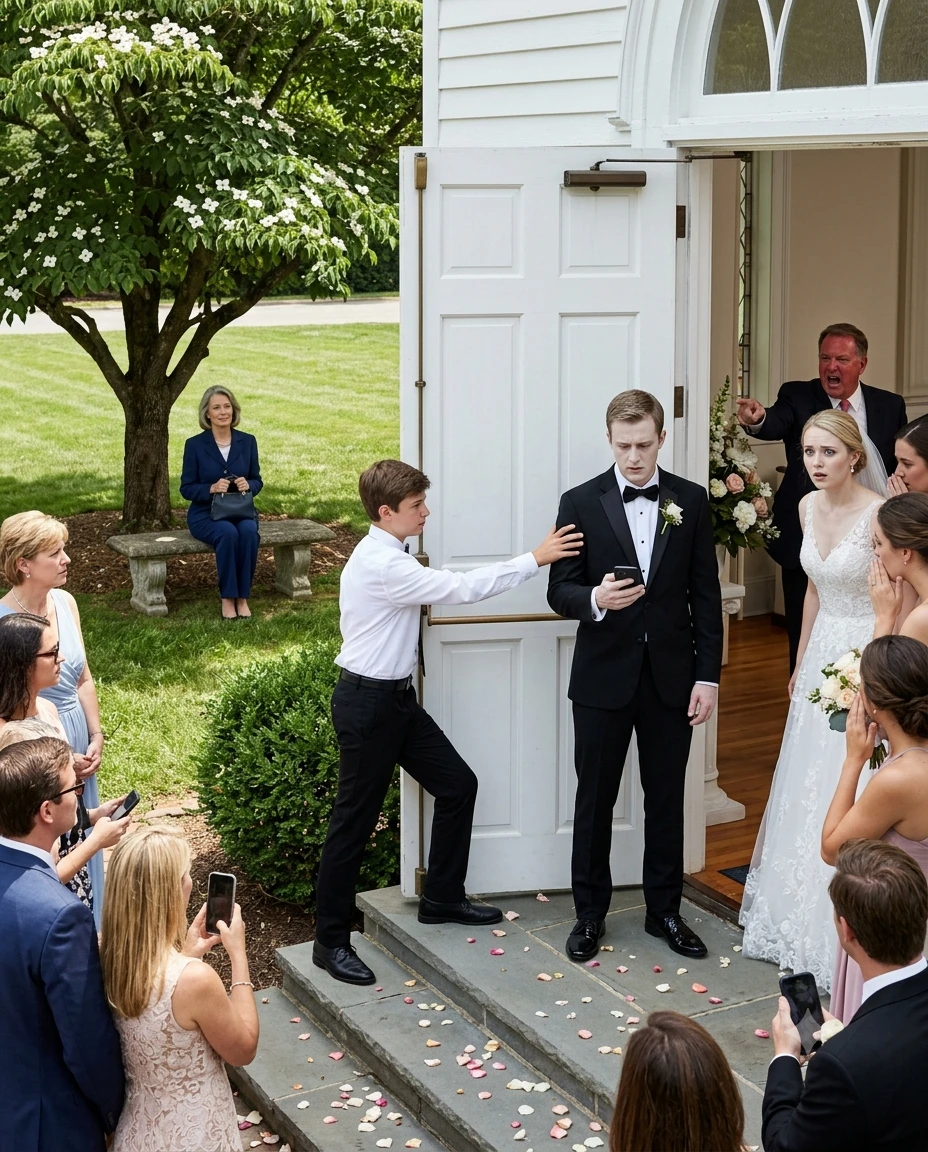
Daniel’s hand started shaking before he reached the bottom of the church steps.
I noticed it immediately.
He had always done that when he was overwhelmed. Even as a little boy.
At seven years old, he did it before piano recitals.
At sixteen, before football tryouts.
At twenty-four, before identifying his father’s body at St. Mary’s Hospital.
And now, standing outside St. Andrew’s Community Church in a tuxedo that suddenly looked too tight across his chest, his fingers trembled around his phone while guests whispered behind him.
The July sunlight bounced hard against the white stone walls of the church. Wind stirred the hydrangeas near the entrance. Somewhere farther down the parking lot, a car alarm chirped twice.
Daniel stared at the screen.
Then he looked up at me.
Not angry anymore.
Confused.
Savannah appeared behind the church doors before he could move.
Her white dress caught the light sharply enough to make her almost glow.
“What’s taking so long?” she asked with a tight smile.
Then she saw Daniel’s face.
The smile disappeared.
He didn’t answer.
His eyes dropped back to the phone.
I already knew what he was reading.
Because at 10:42 a.m., exactly eighteen minutes before the ceremony, Attorney Michael Greene had emailed every member of our immediate family.
Including Savannah.
Including Savannah’s parents.
Including Daniel.
The subject line was simple.
DOCUMENTED FINANCIAL TRANSFERS AND RECORDED COMMUNICATIONS.
Inside were six attachments.
Bank statements.
Voice recordings.
Screenshots.
And one scanned letter written in Frank Parker’s handwriting eleven years earlier.
The same letter I had found in his locked desk drawer.
The same letter Savannah never knew existed.
Daniel looked physically ill.
Savannah reached for the phone.
He pulled it back.
“What is this?” he asked.
Quietly.
That scared me more than yelling would have.
Savannah’s eyes flicked toward me for only a second.
But panic changes people fast.
Her shoulders tightened.
Her jaw locked.
“I don’t know what your mother’s trying to do,” she said quickly.
There it was.
Not confusion.
Not concern.
Defense.
Daniel scrolled lower.
Then his face changed completely.
Two weeks before the wedding, Savannah had accessed Daniel’s online banking account from his laptop while he showered upstairs.
The records proved it.
She transferred $14,800 between accounts.
Then she moved the money back three days later.
Just long enough to create screenshots showing temporary “missing funds.”
Those screenshots were what she had shown relatives while claiming I had manipulated Daniel into supporting me financially.
But Savannah made one mistake.
She forgot banks timestamp everything.
And she forgot Frank had once insisted every financial device in our family use shared cloud backups after a fraud scare years earlier.
Savannah didn’t know Daniel’s old laptop still synced activity reports to a private family storage account Frank created before he died.
I discovered the reports accidentally while searching through Frank’s files after Karen called me.
At first I didn’t even understand what I was looking at.
Then I saw Savannah’s login timestamps.
And the screenshots she later texted to family members.
The metadata matched.
Exactly.
Daniel looked at Savannah slowly.
“Tell me this isn’t real.”
She crossed her arms.
“You’re seriously doing this right now?”
Wrong answer.
Not denial.
Deflection.
Around us, the crowd had gone dangerously quiet.
Guests pretended not to stare while staring directly.
An older woman near the church doors lowered her sunglasses.
One bridesmaid whispered something behind her bouquet.
Savannah’s father came down the church steps quickly.
“What’s going on?”
Daniel turned the phone toward him.
For a full second, the man said nothing.
Then color drained from his face.
Because the recordings were worse.
Three separate audio clips.
All captured through accidental voice assistant activation from Daniel’s kitchen speaker.
One clip included Savannah laughing with her mother while discussing me.
“She’s lonely and emotional,” Savannah said casually. “It’s easy to make people believe unstable women steal money.”
Another clip hit harder.
“Once we’re married, he’ll stop talking to her completely. You just have to isolate men slowly.”
That one nearly broke Daniel where he stood.
I watched it happen.
Watched my son realize his memories of the last year had been rearranged carefully by someone he trusted.
Savannah finally snapped.
“Oh my God, Daniel, are you really falling for this?”
People always become less polished once control slips.
Her voice sharpened.
Her breathing changed.
“You know how manipulative she is.”
That word.
Manipulative.
The same word she had repeated for months.
The same word relatives began using back to me without realizing where it started.
Daniel rubbed one hand over his mouth.
Then he asked the question that mattered.
“Did you tell people my mother stole from me?”
Savannah hesitated.
Only half a second.
But half a second can destroy a life.
“She twisted things,” Savannah said carefully.
Not no.
Never no.
Daniel stepped backward like someone had hit him in the chest.
Inside the church sanctuary, the organ player stopped completely.
Even through the closed doors, the silence felt loud.
Savannah’s father lowered his voice.
“Maybe we should discuss this privately.”
But it was too late for private.
Humiliation spreads fast in church parking lots.
Especially rich humiliation.
Daniel looked at me across the lawn.
And for the first time in almost a year, I saw my son clearly again.
Not the angry version Savannah had shaped.
Not the distant version who stopped calling.
Just Daniel.
Heartbroken.
Ashamed.
Trying to understand how he got here.
He walked toward me slowly.
Savannah grabbed his sleeve.
“Daniel.”
He pulled free.
Not violently.
Just firmly.
That hurt her more.
When he reached the stone bench, he stopped in front of me without sitting.
The dogwood branches moved overhead in soft clicking sounds.
Farther away, a child laughed near the parking lot before being hushed by an adult.
Daniel swallowed hard.
“Why didn’t you tell me?”
I looked at him carefully before answering.
“Because you already decided who I was.”
That landed.
His eyes watered instantly.
My son had inherited his father’s inability to hide grief.
Frank always cried openly during funerals, old movies, military reunions, even retirement commercials.
Daniel used to tease him for it.
Now he stood outside his own wedding blinking hard in front of two hundred guests.
“I thought…” he started.
Then stopped.
Because there was nothing safe to finish that sentence with.
I opened my purse slowly and removed the folded letter Frank had written years earlier.
Daniel recognized the handwriting immediately.
His face crumpled.
Frank wrote the letter after discovering his first signs of heart disease.
Just in case something ever happened unexpectedly.
Inside was one sentence underlined twice.
If anyone ever tries to separate this family using money, follow the records before you follow emotions.
Frank knew people.
Knew weakness.
Knew greed.
Daniel sat beside me heavily.
The church doors opened again behind us.
Guests began quietly leaving.
No wedding music followed them.
Savannah still stood near the entrance in her white dress, arms folded tightly across herself while relatives circled her in tense whispers.
Then came the moment that hurt worst.
Daniel started crying.
Not dramatically.
Not loudly.
Just silent tears sliding down a grown man’s face while church bells rang noon across Middletown.
“I’m sorry, Mom.”
Four words.
That was all.
But after almost a year of silence, suspicion, and humiliation, those four words nearly dropped me to pieces.
I reached for his hand.
The same hand I held crossing kindergarten parking lots.
The same hand that shook while identifying his father.
The same hand now trembling on a church bench beside me.
“We’ll deal with the rest later,” I said softly.
And we did.
The wedding never happened.
Savannah left the church through a side entrance thirty-seven minutes later with her parents.
Three weeks afterward, Daniel learned she had also opened two credit cards in his name connected to wedding expenses.
By September, criminal fraud charges were under review.
Most relatives apologized eventually.
Some didn’t.
Funny how pride works.
Karen came over every Tuesday night after that with pie or soup or gossip magazines like she was trying to stitch the family back together one evening at a time.
Daniel started coming by on Sundays again.
At first quietly.
Carefully.
Like someone returning to a house after a storm.
One October evening, almost exactly a year after Frank died, Daniel fixed the loose porch railing without being asked.
The sound of his toolbox opening in the driveway made something inside me settle for the first time in months.
We sat outside afterward drinking coffee under the porch light while Bengals highlights played softly through the living room window.
Neither of us talked much.
We didn’t need to.
Some losses stay.
Some damage leaves fingerprints forever.
But lies only survive while silence protects them.
And on the morning my son blocked me from his church wedding, silence finally stopped protecting the wrong person.