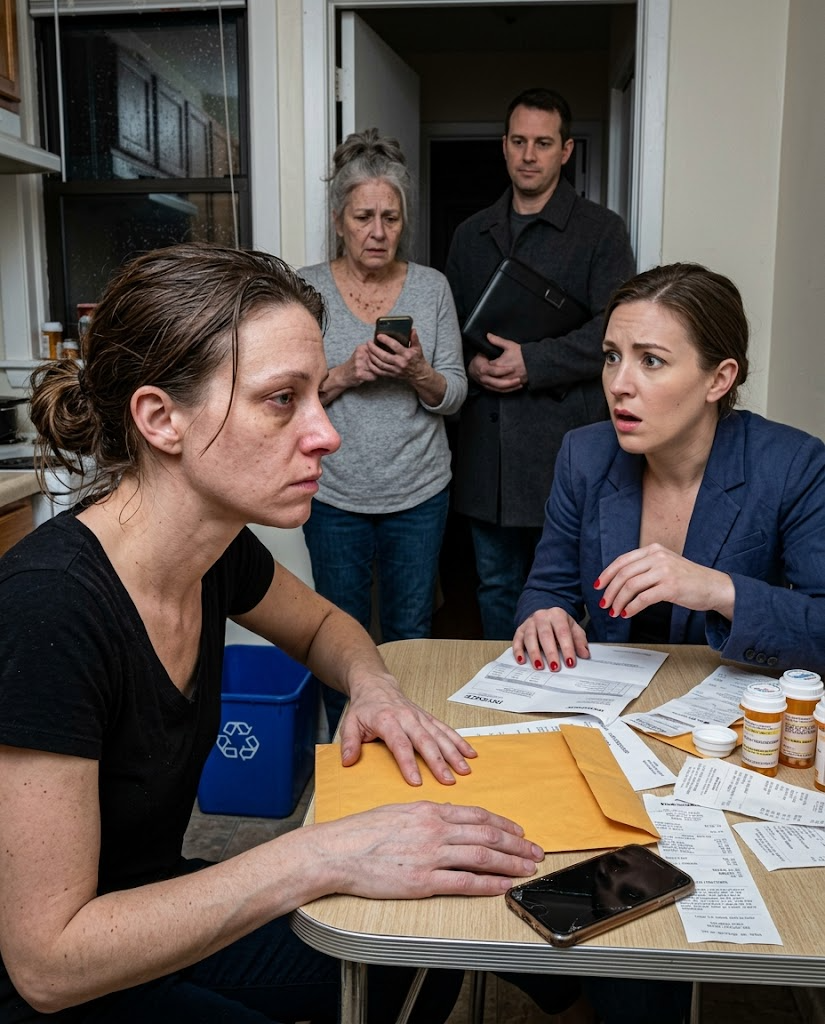
Nathan set the black folder on my kitchen table like it weighed more than paper.
Lauren’s hand stayed frozen above her car repair invoice. My mother stood in the doorway with her phone still pressed to her palm, rainwater beading on the shoulders of her beige coat. Nobody moved toward the chairs.
The apartment had never felt smaller. The radiator clicked twice behind me. The medicine bottles beside the sink gave off that bitter orange pharmacy smell. A wet draft slid under the front door and touched my ankles. On the table, the cracked screen of my phone went dark, taking my manager’s message with it.
Nathan opened the folder.
Page one was not dramatic. That was what made it worse.
No red ink. No angry note. No paragraph begging anyone to understand.
Just a clean spreadsheet printed on white paper.
Family Assistance Ledger — 2017 to 2024.
My name was at the top.
Under it, line after line.
Mark rent transfer, $900. Dad insurance late fee, $417. Lauren daycare emergency, $1,250. Mom utility balance, $386. Mark phone replacement, $612. Lauren school deposit, $700. Dad prescription pickup, $143. Mom property tax shortage, $2,100.
Every item had a date. Every item had a screenshot number. Every item had a note beside it.
Requested by text.
Promised repayment.
No repayment recorded.
Lauren looked down the first column, and the color in her cheeks drained unevenly, starting around her mouth.
My mother took one step closer, then stopped when her eyes reached the total at the bottom.
$42,611.
Nathan turned the page around so they could read it without leaning over me.
“Before anyone says this was family helping family,” he said, “most of these were written as loans in your own messages.”
Lauren’s mouth tightened.
Nathan did not look up.
The rain hit the window harder, a flat scattered sound like rice thrown against glass.
My mother’s fingers closed around the back of the nearest chair. Her knuckles went pale.
“Why would you keep all this?” she asked.
Her voice did not sound angry. It sounded offended, like the receipts had betrayed her.
I looked at the blue plastic bin on the floor.
Because I had learned early that memory bends toward the loudest person in the room.
Because every time I said I was tired, someone answered with a task.
Because calm people need evidence when they finally stop being convenient.
I said none of that.
I reached for my mug, but my fingers missed the handle on the first try. Nathan saw it. My mother saw it too. For once, nobody pretended the shake was nothing.
Lauren pulled her invoice back toward herself.
“This is insane,” she said. “I came here because my car broke down.”
“You came here because you assumed she would pay,” Nathan said.
Lauren’s eyes snapped to him.
“You don’t get to talk to me like that.”
He lifted one page from the folder and placed it beside her invoice.
It was a screenshot. Her name at the top. Her text from 8:04 that morning.
Ask her tonight. She never says no if Mom is on the phone.
The kitchen went quiet in a different way.
My mother’s chair scraped the floor as she finally sat. The sound was sharp enough to make me blink.
Lauren stared at the screenshot. Her red nails curled inward until one of them clicked against the table.
“That was private.”
Nathan’s face stayed calm.
“So were her bank statements.”
My mother put her phone on the table as if it had become too hot to hold.
I noticed the details with strange clarity. The lipstick smudge on the rim of Lauren’s travel cup. The damp hem of Mom’s coat. A thin brown coffee ring beneath my own mug. The little white cap from my cough syrup rolling near the saltshaker.
Mom’s eyes moved to the medicine bottles again.
“What are those for?”
Nobody had asked me a question like that in years.
The words landed too late to be soft.
I opened my mouth, then closed it.
Nathan answered for me.
“Pneumonia two months ago. Recurring bronchitis before that. Stress migraines. High blood pressure. She has been working through medical leave because she used her savings covering family emergencies.”
Lauren made a short sound.
“Oh, come on.”
Nathan slid another paper forward.
Employee hardship review.
My manager’s name. HR’s signature. The note that my missed deadlines had been investigated and linked to documented unpaid caregiving, family financial transfers, and untreated medical issues.
Lauren looked at me then, really looked.
Not at my wallet. Not at my calendar. Not at my ability to make things disappear.
At me.
My sweatshirt was old at the cuffs. My hair had slipped out of its clip. My left eye watered from the kitchen light. There was a bruise on my wrist from the blood draw I had squeezed in before work and hidden under my sleeve.
Her face did not soften.
It changed shape around calculation.
“You told your job about us?”
I laughed once. No humor in it. Just air leaving.
“I told my job why I was collapsing at my desk.”
My mother flinched at the word collapsing.
Lauren pushed back from the table.
“You’re making us sound like monsters.”
Nathan closed the folder halfway.
“No. Your messages are doing that.”
At 8:47 p.m., Mark called.
His name flashed across my phone screen.
Nobody reached for it.
It rang through once. Twice. Three times.
Then a text appeared.
Mom said you’re being weird. I need $600 before midnight. Don’t ignore me.
Nathan looked at the phone.
My mother covered her mouth.
Lauren whispered, “Perfect timing,” but her voice had lost its edge.
Another message came.
You always have something tucked away.
Then another.
Don’t start acting selfish now.
The radiator hissed. Somewhere outside, a car rolled through a puddle, tires dragging water along the curb.
Nathan took a picture of the screen.
Lauren stood.
“You’re not seriously making this legal.”
I finally pulled the chair out and sat down, not because I wanted to soften the room, but because my knees had begun to tremble. The chair was cold through my sweatpants. My lungs scratched when I breathed in.
“I’m not suing anyone tonight,” I said.
My mother’s shoulders dropped by an inch.
Then I added, “I am sending everyone a repayment schedule.”
Lauren’s face tightened again.
“Repayment schedule?”
Nathan pulled a second packet from the folder.
“Thirty days to acknowledge the balance. After that, she can file in small claims for individual amounts or pursue a civil claim for documented larger transfers. I’ve already separated them by person.”
Lauren stared at him like he had spoken another language.
My mother reached for the page with her name on it. Her fingers moved slowly over the listed amounts.
$386. $2,100. $744. $1,600. $89. $312.
Little emergencies she had dropped into my lap, one at a time, because each one sounded too small to break a person.
Together, they had built a wall.
Mom’s eyes filled, but the tears stayed on the lower rims. She did not wipe them.
“I didn’t know it was this much.”
I looked at her.
“You didn’t count.”
The sentence sat between us.
No one reached to move it.
Lauren grabbed her purse from the chair.
“I’m not paying forty-two thousand dollars because you saved receipts like a crazy person.”
Nathan tapped one page with his index finger.
“Your portion is $16,804.”
She stopped with the purse strap halfway over her shoulder.
“My what?”
“Your portion,” he repeated. “Car repairs, daycare, emergency flights, birthday deposits, school fees, phone bills, and the two charges you put on her card in March after telling her they were temporary holds.”
Lauren’s nostrils flared.
My mother turned toward her.
“What charges?”
For the first time all night, Lauren looked trapped.
Not guilty. Not sorry.
Trapped.
She picked up her invoice, folded it badly, and shoved it into her purse.
“This family has lost its mind.”
She walked to the door.
Before she opened it, Mark called again.
Nathan let it ring. The sound filled the kitchen, bright and ugly.
Lauren’s hand closed on the doorknob.
My mother spoke without looking at her.
“Did you tell her to put me on speaker tonight?”
Lauren did not answer.
The rain behind the door sounded louder.
Mom turned her head slowly.
“Lauren.”
Lauren opened the door.
Cold air pushed into the kitchen and lifted the corner of the top receipt.
“She would have said no if you weren’t there,” Lauren said.
Then she left.
The door shut behind her with a flat wooden crack.
My mother sat perfectly still.
Nathan gathered the loose pages and squared their edges against the table. He had always done that when we were kids, even with board games, even with homework. Neat stacks. Straight lines. Proof that something chaotic could be made readable.
At 9:03 p.m., my phone buzzed again.
This time it was my manager.
Please confirm you are safe. We can move your leave start date to tomorrow.
I typed with both thumbs because one hand alone would not hold steady.
I’m safe. Thank you.
My mother watched the message send.
“Tomorrow?” she asked.
“Yes.”
“How long?”
“Six weeks.”
She breathed out through her nose, slow and shaky.
“What will you do?”
I looked at the sink full of dishes, the stack of unopened envelopes, the medicine bottles, the folders, the cold coffee, the blue bin that had carried seven years of being useful.
“Sleep,” I said.
My mother nodded once, but her chin quivered.
Nathan placed a pen on top of her packet.
“This is not for tonight’s payment,” he said. “It’s only an acknowledgment that you received the accounting.”
She picked up the pen.
Her hand hovered above the line.
Then she looked at me.
“I thought you were fine.”
I did not answer right away.
The old version of me would have made it easier for her. I would have smiled. I would have said I knew, it was okay, everybody was busy, don’t worry about it.
Instead, I watched the rain crawl down the black window and let the seconds pass.
Finally, I said, “I know.”
Her pen touched the paper.
The scratch of her signature sounded small, but it changed the room.
Nathan signed as witness. Then he turned the page, handed her the copy, and placed the original back in his folder.
Mark’s messages kept arriving.
Where are you?
Mom?
Lauren said she left.
Is she really doing this?
My mother looked at her phone. She did not pick it up.
For years, everyone had waited for me to answer first.
That night, the phone kept lighting up beside her hand.
She let it go dark.
At 9:18 p.m., Nathan walked to the sink, filled a glass with water, and set it beside my pills.
“Take the antibiotic,” he said.
I did.
My mother watched me swallow it. Her face pinched hard at the sound my throat made.
Then she stood and began gathering the unopened mail beside the microwave. Not fast. Not performative. One envelope at a time.
I did not thank her.
Nathan helped me move the blue bin from the floor to the chair so I would not have to bend down again.
Outside, Lauren’s car was gone from the curb.
Inside, Mark called a fourth time.
My mother finally picked up the phone, answered, and put it on speaker.
His voice came through sharp.
“What is she doing?”
Mom looked at the signed packet in her hand.
Then at the medicine bottles.
Then at me.
“She’s resting,” my mother said.
Mark started talking fast.
Mom pressed the red button before he finished.
The sudden quiet felt unfamiliar.
Not peaceful yet.
Just empty enough for breath.
At 9:26 p.m., I turned my phone face down.
Nathan locked the folder.
My mother stood by the microwave holding a stack of my unpaid bills against her chest, her wedding ring clicking softly against the paper.
Nobody asked me for money again that night.